

Patients often ask me for an acupuncture point chart. Most have seen one online with a hundred dots packed onto a diagram. They want to know which points matter and how to find them on their own body.
Start with a dozen commonly used points. You'll find each one using familiar landmarks on your body, with no ruler needed.
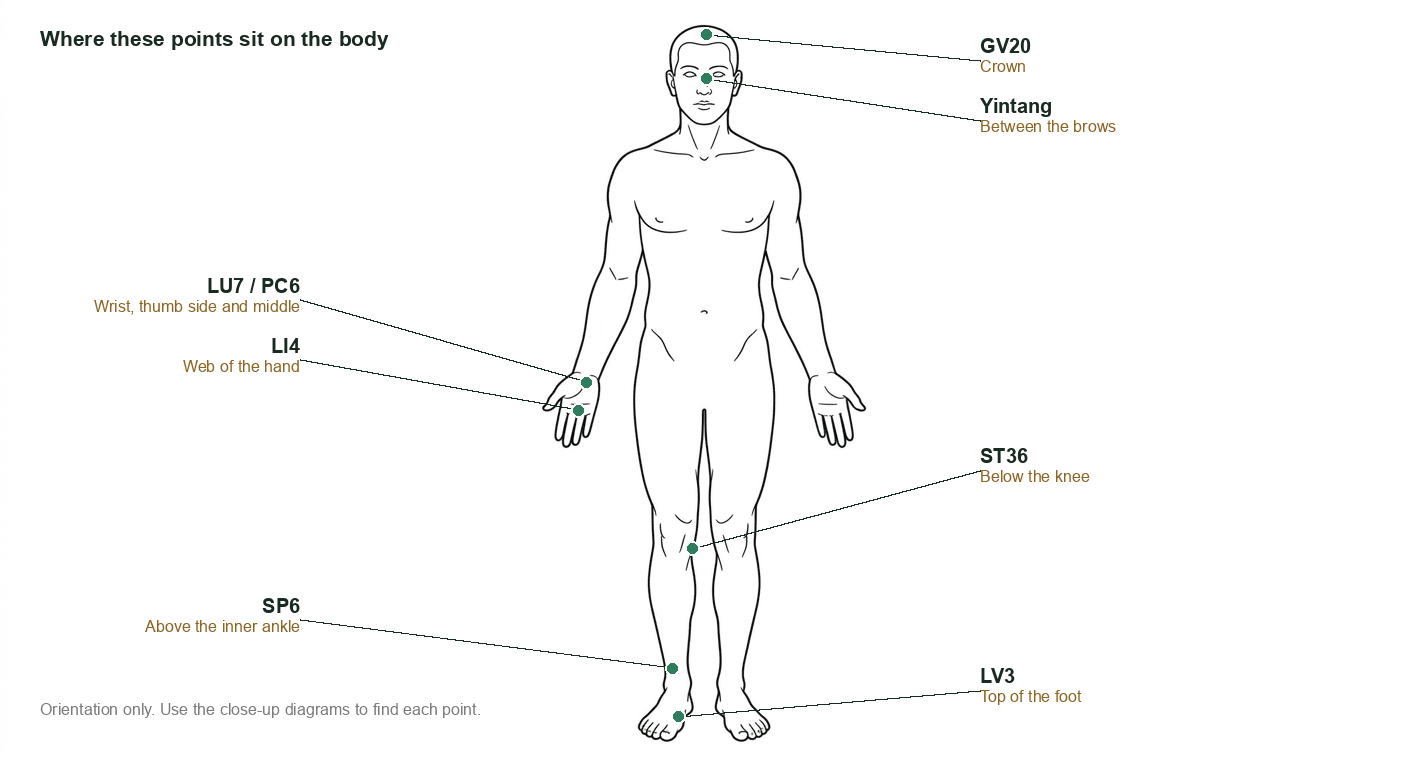
The measuring system nobody explains
Before looking at the points, you need to understand how charts measure distance. Classical acupuncture texts use cun, a unit based on your body's proportions rather than a fixed number of inches or centimeters.
For a rough estimate, the width of your thumb at the knuckle represents one cun. Four fingers held together, measured across the knuckles, represent about three cun. Use your own hand when locating points on your body.
For a point two cun above the wrist crease, two thumb-widths give you an approximate distance. Then use the nearby tendons, bones, or other landmarks to refine the location.
A printed chart gives you a starting position. Your body's proportions and landmarks help you find the point more precisely.
The hand
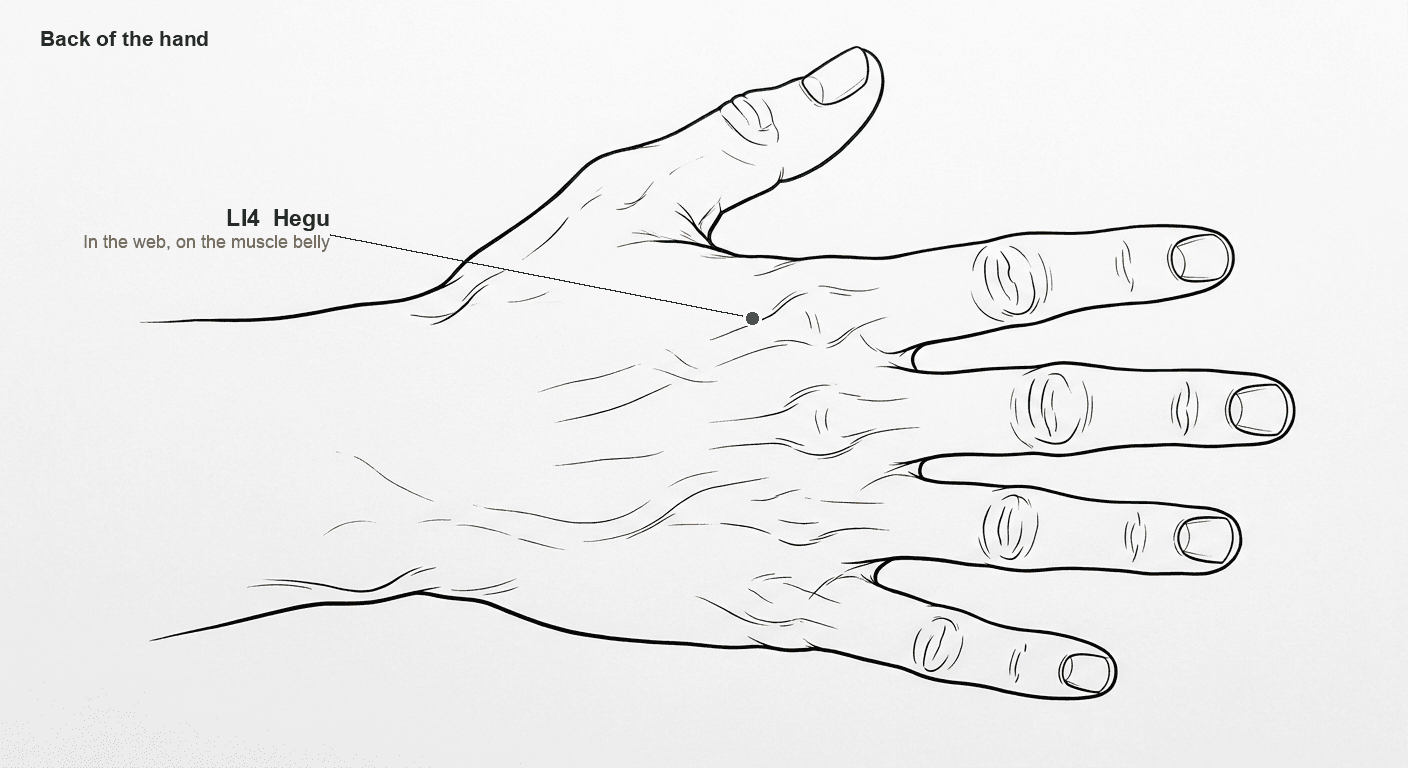
LI4, Hegu
Bring your thumb and index finger together and look for the small mound of muscle between them. The highest part gives you a starting place for locating LI4. The area often feels tender, but soreness alone does not confirm you have found the point.
LI4 is traditionally used for headaches and facial pain. This is one of the points I most often show patients who spend long hours at a desk.
Avoid pressing LI4 during pregnancy. Ask your prenatal care provider or a licensed acupuncturist experienced in pregnancy care for guidance.
The wrist and palm
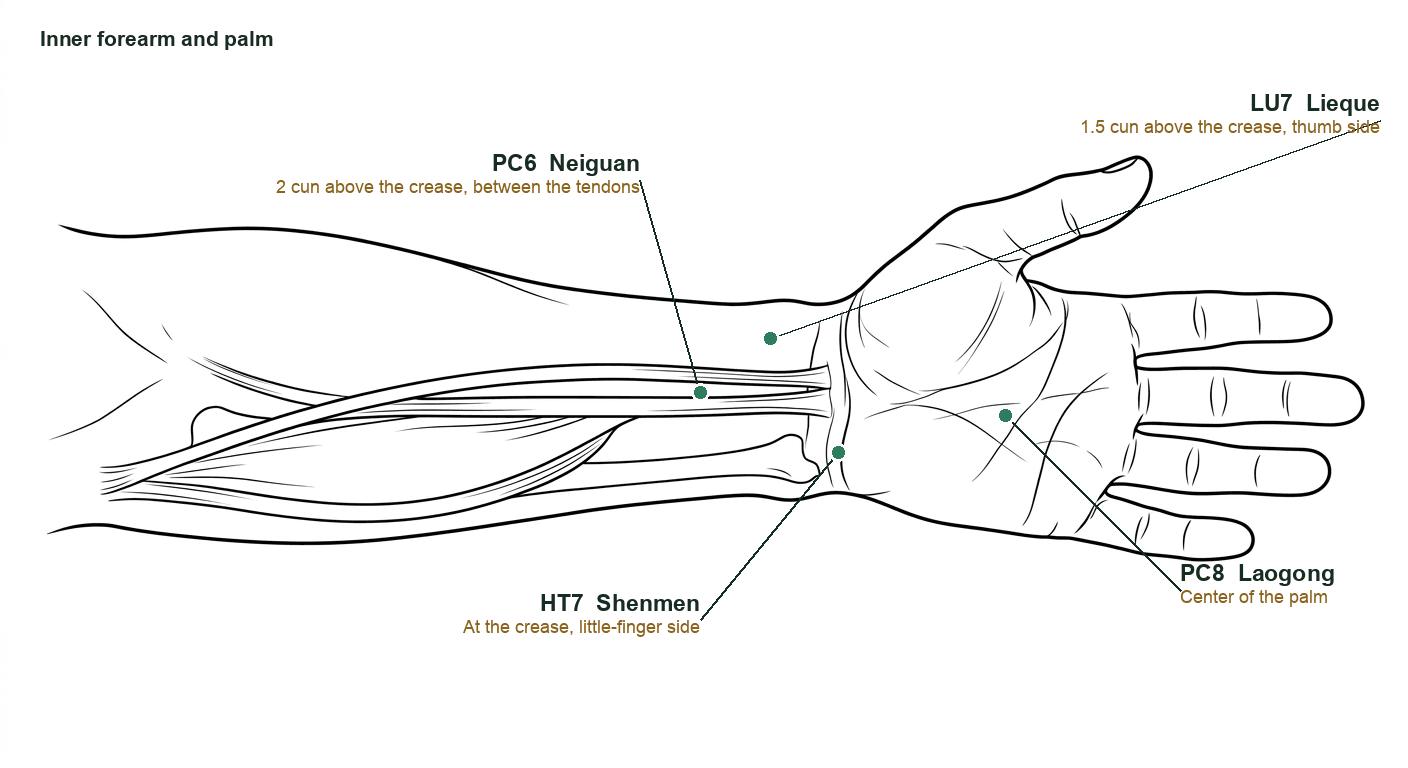
PC6, Neiguan
Turn your palm up and find your wrist crease. Measure about two of your own thumb-widths toward your elbow, then feel for the two tendons near the middle of your forearm. PC6 sits between them.
I often teach this point to patients seeking relief from nausea. Acupressure here is used for motion sickness, morning sickness, and nausea after anesthesia, though results vary. Pharmacy anti-nausea wristbands apply pressure to this same area.
HT7, Shenmen
With your palm facing up, find the wrist crease on the little-finger side. HT7 sits in the small hollow beside the tendon, toward the center of your wrist. In traditional acupuncture, practitioners use this point for sleep difficulties and restlessness.
LU7, Lieque
Nature Acupuncture & Herbs
Ready to feel better?
Our practitioners are accepting new patients at all three Los Angeles locations.
LU7 sits on the thumb side of your forearm, roughly one and a half cun above the wrist crease. Crossing your hands at the thumbs and resting your index finger along the opposite wrist helps you estimate the location. Practitioners traditionally use this point for coughs and neck discomfort.
PC8, Laogong
Make a loose fist and notice where the tip of your middle finger meets your palm. This gives you an approximate location for PC8. Read more in our PC8 article.
The lower leg and foot
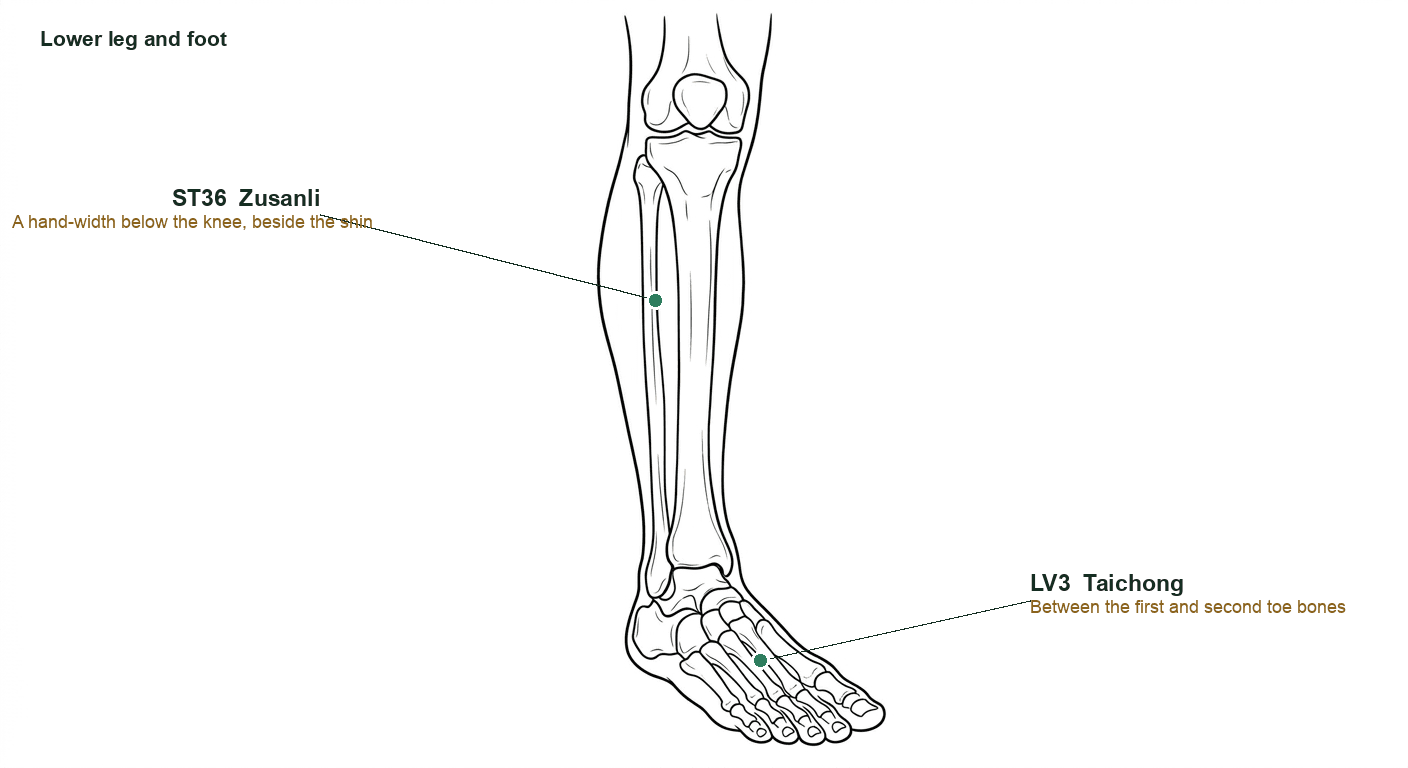
ST36, Zusanli
Sit down and measure about four of your own finger-widths below the kneecap. Find the ridge of your shin bone, then move about one finger-width toward the outside of your leg. You should feel muscle beneath your fingers. Lift your toes toward your shin to feel the muscle move.
In traditional acupuncture, practitioners use ST36 for digestive symptoms, fatigue, and general weakness.
SP6, Sanyinjiao
Find the highest part of the bony bump on the inside of your ankle. Measure four of your own finger-widths upward, then feel just behind the inner edge of your shin bone. The area often feels tender, though tenderness alone does not confirm the location.
Practitioners traditionally use SP6 for menstrual cramps and sleep difficulties. Avoid pressing SP6 during pregnancy.
LV3, Taichong
On top of your foot, slide a finger from the gap between your big toe and second toe toward your ankle. Feel for the hollow before the two metatarsal bones come together.
In traditional acupuncture, practitioners use LV3 for headaches, irritability, and tension.
KI3, Taixi
Find the soft hollow between the bony bump on the inside of your ankle and your Achilles tendon. KI3 sits in this hollow, level with the most prominent part of the ankle bone.
The head and neck
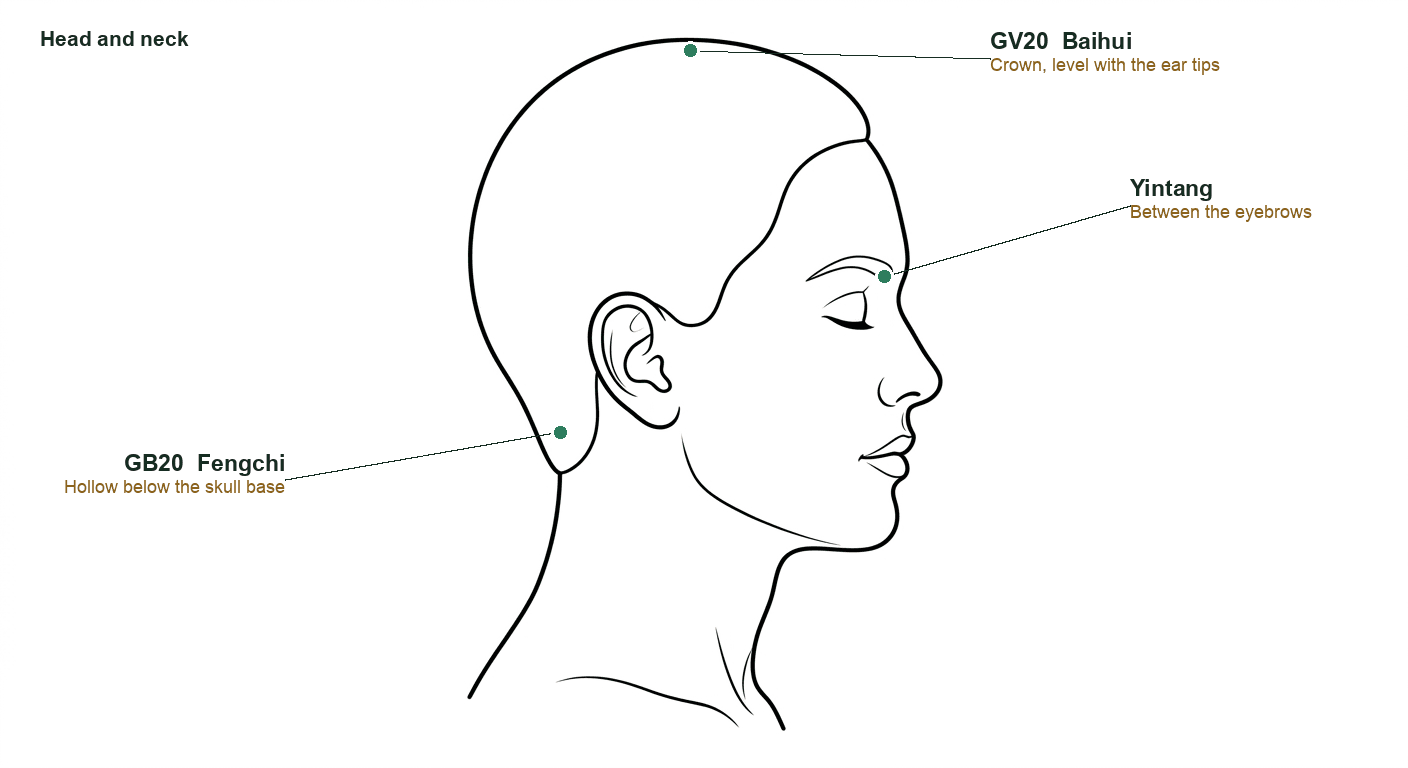
GB20, Fengchi
Slide your thumbs up the back of your neck and feel for the two hollows beneath the base of your skull, one on each side. These areas often feel tender, though soreness alone does not confirm the location. Practitioners traditionally use GB20 for headaches and neck tension. Keep any pressure gentle.
Yintang
Yintang sits midway between the inner ends of your eyebrows. Practitioners traditionally use this point to help with relaxation and restlessness.
GV20, Baihui
GV20 sits on the midline at the crown of your head, approximately where a line connecting the tops of your ears crosses. In traditional acupuncture, practitioners use this point for symptoms such as a heavy-headed feeling.
What pressing them will and will not do
Acupressure uses pressure from your fingers, while acupuncture uses needles. I often teach patients acupressure as a way to manage symptoms between visits. Some people find gentle pressure helpful for temporary relief, though results vary.
Persistent or recurring symptoms deserve an assessment. Choosing a point from a chart does not replace understanding the cause or developing a treatment plan.
Apply gentle, comfortable pressure for a minute or two while breathing normally. Stop if you feel sharp pain, tingling, or numbness. Avoid broken or irritated skin. During pregnancy, ask your prenatal care provider before trying acupressure.
If you want to go deeper on any of these
We have written at length about several of these points and what the evidence says:
- PC8, Laogong
- Pressure points for nausea
- Pressure points for menstrual cramps
- Acupuncture points for cough
If you're considering acupuncture for a specific concern, talk with us about your symptoms and what you hope to improve. We see patients at three clinics across Los Angeles, and we'll be honest about whether our care is a good fit for you.
Nature Acupuncture & Herbs
Ready to feel better?
Our practitioners are accepting new patients at all three Los Angeles locations.


