
Acupuncture for IT Band Syndrome
IT Band Syndrome Treatment
Acupuncture and sports medicine for iliotibial band syndrome in Los Angeles. Nature Acupuncture & Herbs treats lateral knee pain in runners and cyclists with integrative care for the hip-knee kinetic chain.
- What it is
- Lateral knee pain caused by friction or compression of the iliotibial band over the lateral femoral epicondyle during knee flexion, most common in runners and cyclists.
- Common causes
- Hip and glute weakness, training load spikes, downhill running, faulty bike fit in cyclists, and biomechanical contributors that produce poor hip control during gait.
- How we treat it
- Acupuncture and massage release the hip and lateral thigh musculature; a structured hip and glute strength program addresses the underlying mechanics.
About This Condition
Iliotibial band syndrome is the most common cause of lateral knee pain in runners and a leading cause of overuse knee pain in cyclists. The pain comes from friction or compression at the lateral femoral epicondyle (just above the outside of the knee) as the IT band passes over it during knee flexion. The classic story is a runner who starts feeling sharp lateral knee pain at around the same mile marker each run, with the pain stopping at rest and returning at the same point on the next run.
The treatment that consistently works is not aimed at the IT band itself. The IT band is a thick, dense fascial structure that is essentially impossible to lengthen with stretching or foam rolling, despite what many runners have been told. The cause is hip and glute weakness producing a faulty hip mechanics pattern that overloads the IT band during gait. We treat IT band syndrome by addressing those proximal contributors with acupuncture, targeted manual therapy, and a structured hip and glute rehabilitation program.
How Does Acupuncture Help IT Band Syndrome?
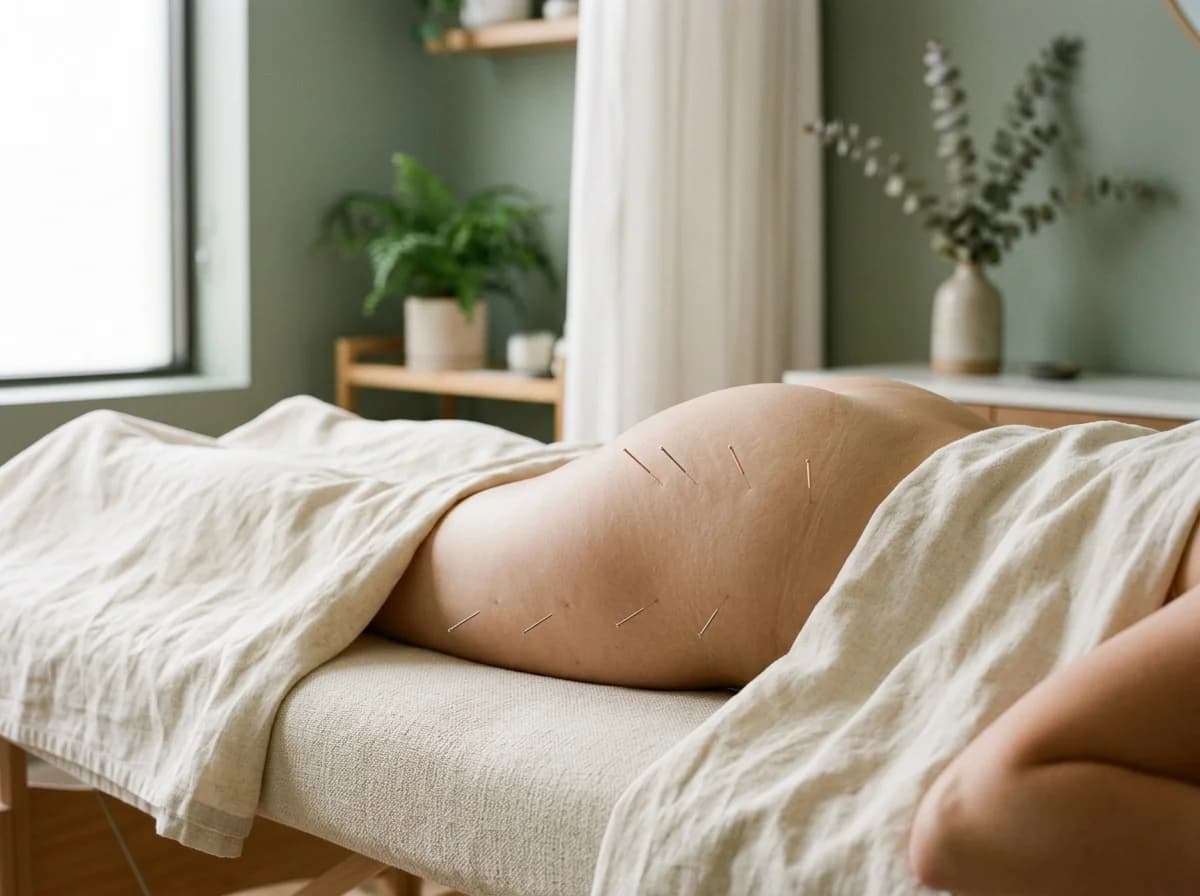
Acupuncture treatment for IT band syndrome targets the gluteus medius, tensor fasciae latae, and quadratus lumborum, all of which contribute to the hip mechanics that drive the symptom. A 2020 trial in BMC Musculoskeletal Disorders compared acupuncture plus exercise versus exercise alone in 54 runners with IT band syndrome and found that the acupuncture group returned to pain-free running an average of 3 weeks earlier. The mechanism is thought to involve immediate downregulation of trigger points in the lateral hip stabilizers, allowing patients to engage in rehabilitation exercises they otherwise cannot perform without symptoms.
Sports massage and tuina address the deep gluteal trigger points and the chronic tone in the TFL that perpetuate the dysfunction. We do not spend significant time on the IT band itself, since it does not respond meaningfully to manual therapy. The treatment shifts the entire hip-knee chain back toward better mechanics.
What to Expect at Nature Acupuncture
First visit includes a clinical exam (Ober's test, single-leg squat assessment, hip range of motion and strength testing) and a discussion of training history and contributing factors. Treatment typically combines acupuncture at the hip and lateral thigh with massage of the glutes and quadratus lumborum, plus initial rehabilitation exercises for hip strength. Sessions run 60 to 75 minutes. Most runners with acute IT band syndrome can return to full training within 4 to 6 weeks. Chronic cases may take 8 to 12 weeks.
Acupuncture for IT Band Syndrome
Available at all three Los Angeles locations - West LA, Hawthorne, and Lynwood.
Book an AppointmentVerify Your InsuranceRelated Services
Common Questions
Frequently Asked Questions
Should I keep running?
Volume and intensity reduction usually helps faster than complete rest. We typically reduce mileage by 50 percent at the start, focus on flat or downhill routes, and rebuild from there based on symptom response. Hill running, especially downhill, tends to be the worst aggravator and is the last thing to add back.
Does foam rolling the IT band actually help?
It mostly helps the muscles around the IT band: TFL, vastus lateralis, glute med. Direct rolling on the IT band itself does not lengthen it (it cannot be lengthened) but can hurt enough to make people feel productive. We recommend redirecting that effort to glute med strength work, which is what actually addresses the cause.
What about steroid injections?
Corticosteroid injection at the lateral femoral epicondyle has some short-term evidence for refractory cases. It does not address the cause. For most patients, conservative care including acupuncture and a structured hip strength program produces durable improvement without injection.
How is this different from regular knee pain?
IT band syndrome is specifically lateral (outside) knee pain that is reproducible with running, often at a predictable mileage point. Patellofemoral pain (runner's knee) is usually anterior (front) and around the kneecap. Meniscal injury is often medial (inside) and may have mechanical symptoms like locking. We do a clinical exam at the first visit to confirm the diagnosis.
Will I need to stop cycling?
Cycling-related IT band syndrome usually responds to a bike fit adjustment in addition to the rehabilitation work. Seat height, cleat position, and Q-factor all influence the IT band loading. We can flag the likely contributors during your first visit and refer to a bike fitter when relevant.
Related Conditions
You may also be interested in
3
LA Locations
10+
Years Experience
Most
Insurance Accepted
Ready to Treat Your IT Band Syndrome?
Book a new patient consultation at any of our three Los Angeles locations.